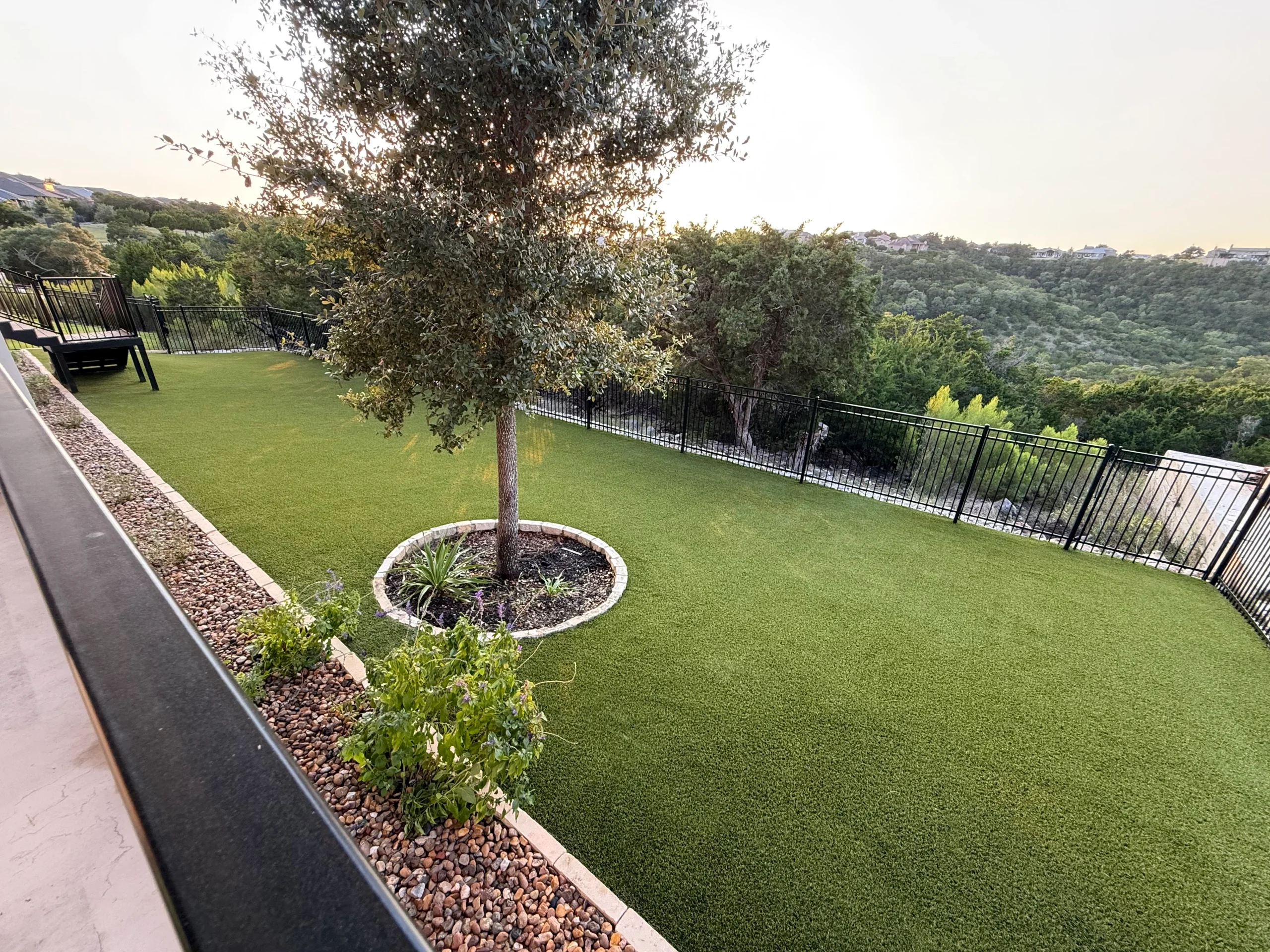
Drainage is the foundational issue for synthetic turf installation in the Houston Ship Channel corridor. Get the drainage right and the surface performs for 15 to 20 years. Get it wrong and you have standing water, base aggregate failure, seam separation, and a surface that needs to come out and be done over. We've seen both outcomes enough times in this corridor that drainage design is how we start every scope — not how we finish it.
The challenge in this corridor is specific: Houston's rainfall intensity is extreme. The National Weather Service gauge at the Ship Channel records 3 to 5 inch rainfall events as normal, not exceptional. A turf drainage system designed for typical residential irrigation runoff will fail under the actual rainfall loads that hit properties in Deer Park, Channelview, and La Porte on a regular basis. The spec has to be designed for the real climate, not average conditions.
Beaumont clay adds a second drainage challenge. Clay soils have very low native permeability — water moves through them at a rate of less than half an inch per hour in most cases. The aggregate base above the clay is responsible for all meaningful drainage. If the base aggregate depth is insufficient, the aggregate fills with water faster than it can move to the drainage outlet, and you get saturation that keeps the base wet and accelerates base aggregate failure. The aggregate base depth and drainage outlet capacity have to be matched to each other and to the expected rainfall load.
For flood zone properties in Channelview, Baytown, Jacinto City, and portions of La Porte and Seabrook, drainage system design goes beyond the standard base-plus-perimeter-drain approach. Flood zone properties need drainage infrastructure sized to handle flood event water movement, not just daily rainfall. On some flood zone properties, the drainage design needs to route water to an improved outlet — a Harris County Flood Control channel, a municipal storm drain with verified capacity, or a French drain that connects to a drainage outlet with sufficient capacity. We assess the outlet capacity before finalizing the drainage design on every flood zone property.
We also address an issue that most general turf contractors don't discuss: drainage system design for properties where the lot grade directs water toward the structure rather than away from it. This is not uncommon on older Beaumont clay lots where decades of clay movement have altered the original grade. Installing turf without addressing negative grade creates a drainage problem that the turf system alone cannot solve.