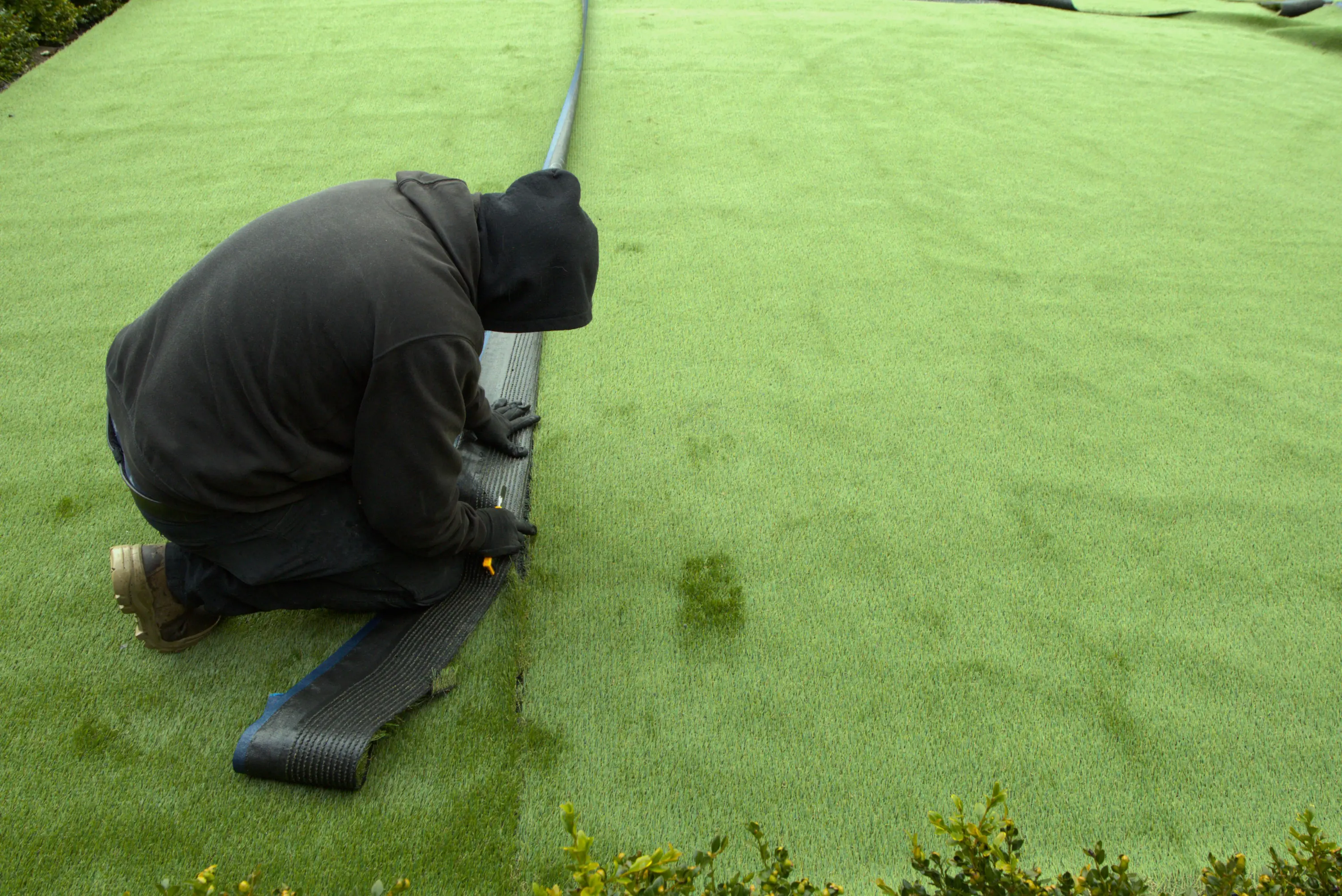
Infill is the material in the base of synthetic turf fiber that provides cushioning, supports blade upright orientation, provides ballast, and in pet applications actively manages odor. Over time and under traffic, infill migrates to the edges of the install area, compacts under load in high-traffic zones, and in the Ship Channel corridor specifically becomes contaminated with industrial particulate that changes its drainage and odor management performance.
Most synthetic turf owners in this corridor don't think about infill until they notice the surface looking flat, the blades lying down instead of standing up, or the surface feeling harder than it originally did. Those are the signs of infill depletion. The fix is infill replenishment — adding fresh infill to depleted zones and redistributing existing infill where it has migrated to low-traffic areas.
In the Ship Channel corridor, infill contamination from industrial fallout is a specific issue that doesn't come up in suburban markets. Particulate from the refinery and chemical plant complex settles through the blade fiber and into the infill layer. Over 3 to 5 years of accumulation without cleaning, the particulate content in the infill can affect drainage performance — finer particulate fills the void spaces in the infill aggregate and reduces the drainage rate. If you've noticed your turf draining slower than it used to, particulate-contaminated infill is a likely cause.
For pet zones specifically, infill replenishment is the primary maintenance intervention that restores odor management performance. Zeolite infill has a finite ammonia absorption capacity — once saturated, it stops actively managing odor. Zeolite replenishment replaces the saturated material with fresh zeolite that can absorb again. On a properly maintained pet zone with weekly cleaning, zeolite life is typically 3 to 5 years. On a zone that hasn't been maintained on schedule, it may be 1 to 2 years.
We match infill type on replenishment jobs. If your original install used silica sand infill, we add silica sand. If it used zeolite, we add zeolite. If you want to upgrade the infill type during replenishment — for example, changing from crumb rubber to a zeolite blend on a pet area — we can do that during the replenishment process. We document the infill type and weight added for your maintenance records.