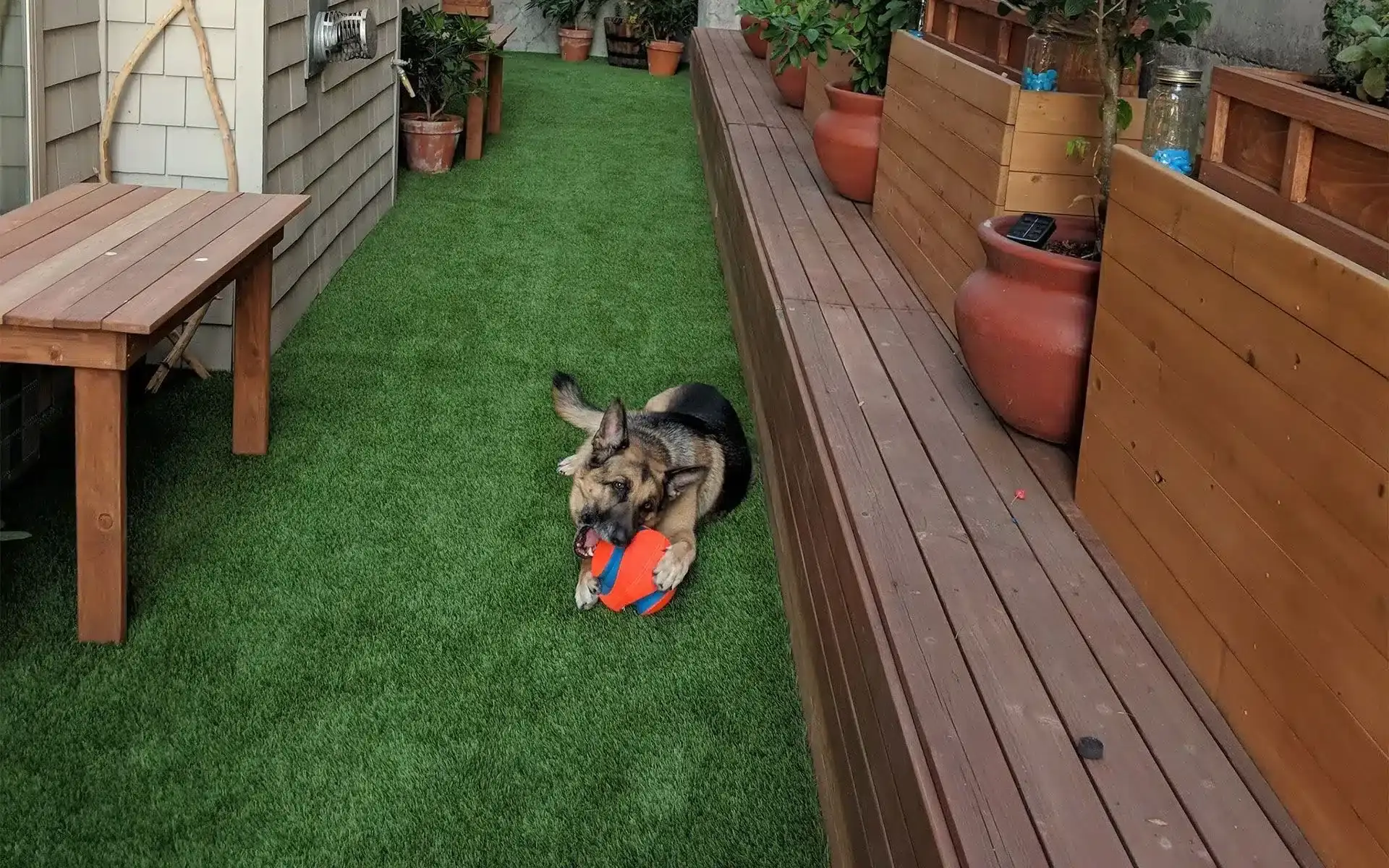
If you have dogs in a Ship Channel corridor neighborhood, you already know what the back yard looks like after six months. The clay soil compacts under paw traffic, drainage backs up at the fence line, and whatever grass was there gets beaten into bare dirt or permanent mud. Then add the refinery soot that settles on every outdoor surface and you have a situation where the dogs are tracking the yard into the house and there's nothing to clean the yard with except rain.
Pet turf installations in this corridor require a more specific product and drainage spec than a standard landscape turf install. The issues are distinct: drainage has to move urine off the surface quickly in 85%+ humidity conditions, or you get ammonia buildup that becomes a permanent odor problem. The infill has to manage odor without trapping heat to the point where the surface is uncomfortable for the dogs during summer afternoons. And the maintenance protocol has to be realistic for a working household — weekly hose-down minimum, not the once-a-month cadence you use for a general landscape area.
We've installed pet turf on enough Ship Channel corridor properties to know what works and what doesn't in this specific environment. Here's what the spec calls for: a crushed granite base with a drainage coefficient adequate to move a full dog urination event off the surface within 60 seconds — meaning at least 30 inches per hour drainage rate through the base aggregate. Most standard landscape turf installs in this corridor don't specify drainage rate explicitly. We do.
Infill selection for pet areas in this climate matters. Standard crumb rubber infill holds ambient heat — on a Houston summer afternoon, rubber infill surfaces can be uncomfortable for dogs with sensitive paws. We use zeolite-blend infill or acrylic-coated sand on pet installations: zeolite absorbs ammonia actively and reduces odor between cleanings, and acrylic-coated sand stays cooler than rubber in direct sun. The cost difference is meaningful per square foot, but the performance difference in a Houston summer pet yard is substantial.
Maintenance protocol is something we explain explicitly at the consultation because it differs from general landscape turf maintenance. Pet areas in this corridor need weekly rinse-down minimum — not monthly. The combination of urine, soot fallout, and humidity creates odor accumulation faster than any other setting we install in. If your household can commit to weekly cleaning, pet turf works well here. If you're looking for zero-maintenance, we'll tell you the product won't meet your expectations.